
Montgomery County Youth Center Outcomes
The official facility description frames the Youth Center’s work around care while the court decides whether a young person returns to the community or moves elsewhere. Those outcomes depend on the juvenile case, the judge’s order, and the plan approved for the youth. The facility is not the final legal authority for secure-detention release.
| Recorded outcome | What it means |
|---|---|
| Return to community | The court authorizes the youth to leave detention for an approved community setting or responsible adult. |
| Another placement | The youth leaves this facility but remains in the setting or placement approved by the court. |
| Continued detention | No release from secure detention has been authorized, even if a hearing or review took place. |
| Court-directed change | The exact order controls, and the destination or terms should be described only as authorized. |
A court hearing date is not itself a release date. Nor does an order always reveal the time that transportation or discharge was completed. An authorized family member or lawyer may need both the court direction and facility confirmation to understand when the change took effect.
Confirm Montgomery County Youth Center Releases
No public adult-inmate lookup was verified for this facility, and none should be created from indirect sources. A person entitled to information should use a focused sequence that protects the youth’s identity and asks each office only for records it is authorized to provide.
- Confirm that Montgomery County Youth Center, rather than an adult jail or another placement, was the relevant facility.
- Use the juvenile case information already held by the youth, authorized family member, or counsel. Do not post private identifiers in a public search.
- Ask Juvenile Court or counsel for the exact order governing secure detention, return to community, or placement elsewhere.
- Contact the Youth Center through its official number for lawful facility-level routing and timing information.
- Describe an exit according to the record. A move to another placement is not a community release.
The general Montgomery County release records path covers adult county, state, and federal systems. Its public locator methods do not override juvenile confidentiality. When a youth’s matter is restricted, the correct result may be direct communication only with the court, facility, counsel, or another person recognized by law.
Keep the proof tied to its source. A judicial order shows what the court authorized. Facility information can show whether the Center carried out the transition, when disclosure is permitted. A receiving placement may confirm that care continued elsewhere. None of these facts should be inferred from the absence of a public name result. When the exact destination is protected, state only that the youth left for an approved placement if an authorized record supports that wording.
Montgomery County Youth Center Access
Juvenile identity and case information is restricted. That affects how a status question can be asked, what an office may confirm, and whether any part of a record can be disclosed. A missing public result is expected in a protected system and cannot prove that no detention, hearing, release, or placement occurred.
Adult methods are especially risky here. Montgomery County’s adult criminal docket and MCCF discharge channels serve different records. The Pennsylvania Department of Corrections locator covers people under state corrections jurisdiction or supervision, not a Youth Center roster. PA SAVIN/VINELink also should not be treated as a way around juvenile access rules. No adult search product can create a right to information about a minor.
The Pennsylvania UJS Portal may omit or restrict juvenile, sealed, expunged, limited-access, and retention-destroyed matters. That is an access boundary, not a false negative to defeat with broader searching. Certified adult criminal filings come from the Clerk of Courts, but that route should not be presented as an open juvenile release archive. An authorized participant should follow the direction given by Juvenile Court or counsel for the particular case.
- Secure detention
- A locked juvenile setting used while the court addresses an alleged delinquent act and next placement.
- Non-secure shelter
- A residential care setting within the Youth Center that is distinct from the secure detention unit.
- Placement
- Another court-approved setting that may continue after the Youth Center stay ends.
- Community return
- A court-authorized move from facility care to an approved community plan.
These terms should not be collapsed into the word “released.” The outcome and legal authority matter. If public disclosure is limited, respect the restriction rather than trying to reconstruct a youth’s identity from news, social posts, or adult record systems.
Montgomery County Youth Center Capacity
Montgomery County describes the Youth Center as a coeducational residential facility with two distinct care settings. The numbers are capacity figures, not a current population count or a release statistic. They help explain why a single adult-jail label would be inaccurate.
The official Montgomery County Youth Center profile shown below is the source for the facility description and bed breakdown.
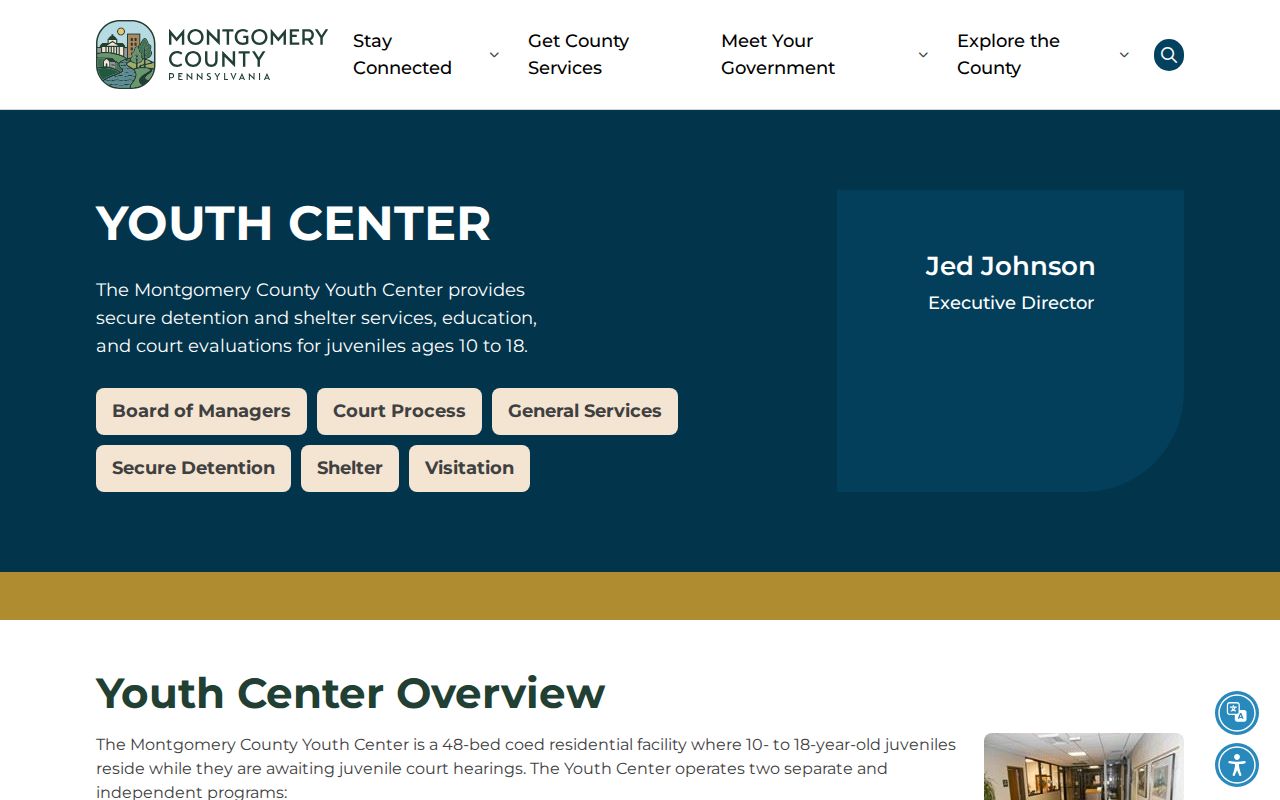
The split between secure and shelter beds reinforces the need to identify the unit and court outcome before describing how a youth left the facility.
Montgomery County Youth Center Contacts
Use the facility contact for questions that may lawfully be routed at the Youth Center. Published research identifies the address and main phone number, but it does not provide a separate public records desk, public search portal, or verified office hours. Do not invent one.
Montgomery County Youth Center
540-550 Port Indian Road
Norristown, PA 19403
Phone: 610-631-1893
Hours: Confirm by phone
When calling, identify the relationship to the youth and ask which office can lawfully address the question. Staff may limit what they disclose. A public caller should not expect the same access as the youth, a parent or guardian, counsel, or a person authorized by the court.
Montgomery County Youth Center Court Roles
The juvenile judge and the facility answer different parts of the inquiry. The judge authorizes release from secure detention and directs the legal outcome. The Youth Center carries out the approved transition and maintains its own operational information. Counsel may hold the best copy of the order and can interpret which people are permitted to receive case information.
A court direction to return to the community is stronger evidence of legal authority than a rumor that the youth is no longer at the Center. Facility confirmation can address whether the transition occurred, subject to access limits. If the order instead names another placement, describe the event as placement or transfer. The youth has left the Port Indian Road facility but has not necessarily left residential care.
Juvenile, sealed, expunged, limited-access, and retention-destroyed records may not appear through public court tools. That absence is not a finding about the youth. It is a reason to use authorized channels and avoid publishing identifying details.
Youth Center Versus Adult Custody
Montgomery County operates adult and juvenile facilities for different populations and under different record rules. MCCF houses adult men and women awaiting trial or serving county sentences. SCI Phoenix is a state prison operated by PADOC. The Youth Center serves youth awaiting Juvenile Court action in secure detention or non-secure shelter care.
Those systems should never be merged. MCCF admission/discharge records can document an adult county-jail exit. PADOC’s locator can show state custody or supervision within its current coverage. Neither is a Youth Center release list. Likewise, an adult booking photograph route does not apply to a minor’s restricted juvenile record.
Note: Leaving the Youth Center for another approved placement is a facility exit, not proof that all court oversight has ended.
Accurate language protects the record and the young person. State only what the authorized court or facility source confirms, distinguish community return from placement elsewhere, and avoid sharing restricted identity information.